
The Best Easy Sugar Cookie Icing Recipe That Hardens Perfectly (No Royal Icing Hassle!)
Welcome to the ultimate guide for creating the best sugar cookie icing you’ll ever make! This incredible recipe delivers an icing that hardens beautifully without becoming overly crunchy, boasts a rich vanilla flavor, and can be effortlessly colored to match any festive occasion. Whether you’re decorating for a holiday, a birthday, or just a fun baking project, this foolproof icing will elevate your sugar cookies to a professional level, all while being incredibly simple to prepare.

Crafting homemade icing for your beloved sugar cookies doesn’t have to be a daunting task. In fact, it’s remarkably straightforward, requiring just four fundamental ingredients along with your choice of food coloring. Forget the complexities of traditional royal icing or the disappointment of runny, sticky glazes. This recipe is designed for ease, reliability, and most importantly, delicious results.
After countless trials and meticulous adjustments, I can confidently attest that this icing pipes with exceptional smoothness, making both intricate outlines and seamless flood fills an absolute breeze. Its delightful taste perfectly complements your sugar cookies, and it sets up gorgeously, providing a pristine, stackable finish. This isn’t just another icing recipe; it’s *the* recipe that will change your cookie decorating game.
The beauty of this homemade icing lies in its incredible versatility. Feel free to customize it with any food coloring you desire to perfectly suit the occasion. You can even divide a single batch into multiple bowls to create a vibrant palette of colors, allowing your creativity to soar. When it comes to decorating sugar cookies with this icing, truly, the sky is the limit!
Why This Sugar Cookie Icing Recipe is Your New Favorite
If you’ve ever struggled with royal icing, finding it too finicky, difficult to work with, or prone to cracking, then this sugar cookie icing is about to become your new best friend. Unlike many other recipes, this one offers a balance of ease and elegance. Here’s why it stands out:
- Perfect Texture: It sets firm enough to allow for stacking and intricate designs, but maintains a soft bite. You won’t chip a tooth on these cookies!
- Rich Vanilla Flavor: The vanilla extract isn’t just an afterthought; it’s a key ingredient that infuses the icing with a warm, inviting aroma and taste, enhancing the overall cookie experience.
- No Egg Whites Needed: This recipe skips raw egg whites, which are often found in traditional royal icing, making it simpler and safer for everyone to enjoy.
- Effortless Piping: Whether you’re a beginner or an experienced decorator, you’ll find this icing incredibly easy to pipe. It holds its shape for outlines and floods smoothly for fills.
- Vibrant Colors: It takes food coloring beautifully, allowing you to achieve bright, vivid hues for any theme or celebration.
- Quick to Set: While full hardening takes time, the initial set is relatively fast, reducing the chances of smudges.
This recipe provides a fantastic alternative to traditional royal icing, eliminating the need for meringue powder or concerns about humidity affecting your decorations. It’s designed to give you consistent, beautiful results every time.
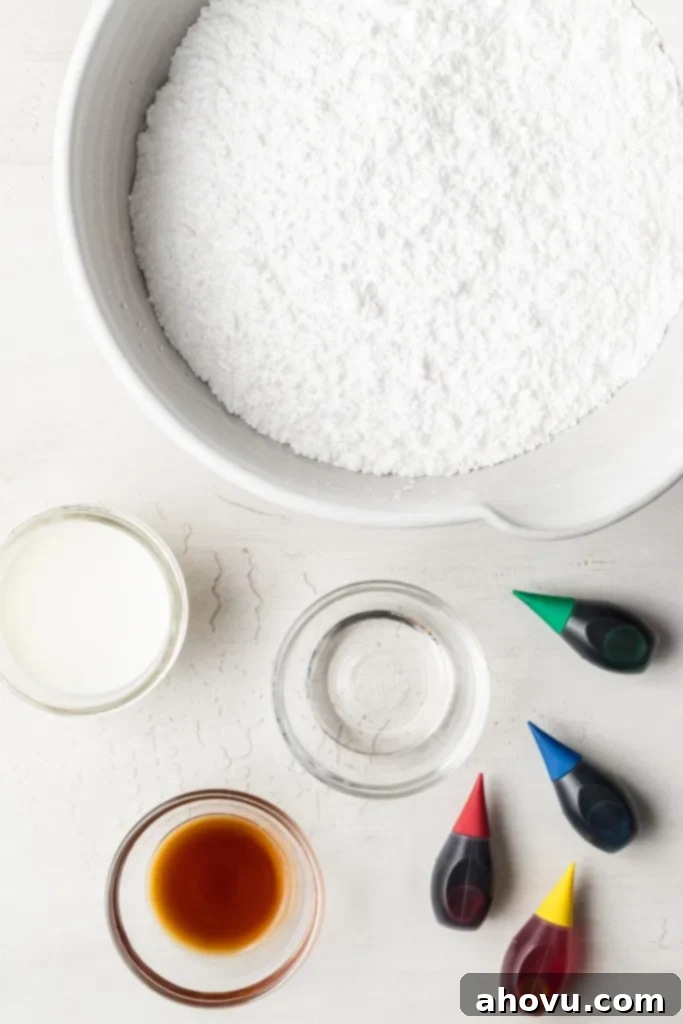
Essential Ingredients for Your Perfect Cookie Icing
To whip up this marvelous homemade sugar cookie icing, you’ll need just a handful of common pantry staples. Each ingredient plays a crucial role in achieving that perfect texture, flavor, and shine:
- Powdered Sugar: Also widely known as confectioners’ sugar or icing sugar, this is the foundational component of our icing. Its finely milled texture dissolves seamlessly, creating a smooth and lump-free base. You’ll begin with a generous 4 cups of powdered sugar, ensuring plenty of icing for a large batch of cookies. Always sift your powdered sugar before measuring and mixing to prevent any lumps from forming in your final icing!
- Milk: The beauty of this recipe is its flexibility when it comes to milk. Any type of milk you have on hand will work wonderfully – be it whole milk, 2%, 1%, skim, or even non-dairy alternatives like almond milk. Each provides the necessary liquid to create a creamy consistency. If you find yourself without any milk, don’t fret! An equal amount of water can be used as a direct substitute, though milk can add a slight richness to the flavor.
- Vanilla Extract: This ingredient is key for imparting that signature, comforting flavor to your icing. If your goal is to achieve a pure, brilliant white icing – especially if you’re not planning to color it or want crisp white details – I highly recommend using clear vanilla extract. Otherwise, for colored icings or if you appreciate the subtle amber hue, pure vanilla extract works perfectly and offers a superior, more robust vanilla taste.
- Light Corn Syrup: This is our secret weapon for both aesthetics and functionality. Light corn syrup helps the icing set up a little faster, reducing drying time, and also contributes to a beautiful, glossy, and professional-looking shine on your finished cookies. If you don’t have any corn syrup available, you can certainly leave it out, but be prepared for a slightly less shiny finish and potentially longer drying times. If omitting, you might need to use a tiny bit more milk to reach the desired consistency.
- Food Coloring: The fun part! You have the option of using either liquid or gel food coloring to bring your icing to life with vibrant hues. Keep in mind that liquid food coloring can thin out the icing slightly, so if you use a lot for a dark color, you might need to compensate by adding a touch more powdered sugar. For truly vibrant, rich, or darker colors without significantly altering the icing’s consistency, I strongly recommend opting for high-quality gel food coloring, such as AmeriColor or Wilton’s concentrated gels.
How to Make Sugar Cookie Icing: A Step-by-Step Guide
One of the brilliant aspects of this recipe is that a single batch of icing can be expertly transformed into both the outline consistency and the flood consistency you’ll need for decorating. To get started, gather two mixing bowls and two piping bags (or more if you’re planning multiple colors). Here’s how to create your perfect outline icing:
- In a large mixing bowl, combine the finely sifted powdered sugar, 5 tablespoons of milk, the light corn syrup, and your chosen vanilla extract. Begin whisking these ingredients together thoroughly.
- Continue to whisk the mixture diligently until it is entirely smooth and no lumps of powdered sugar remain. At this initial stage, the icing will be quite thick and somewhat stiff – this is perfectly normal and expected!
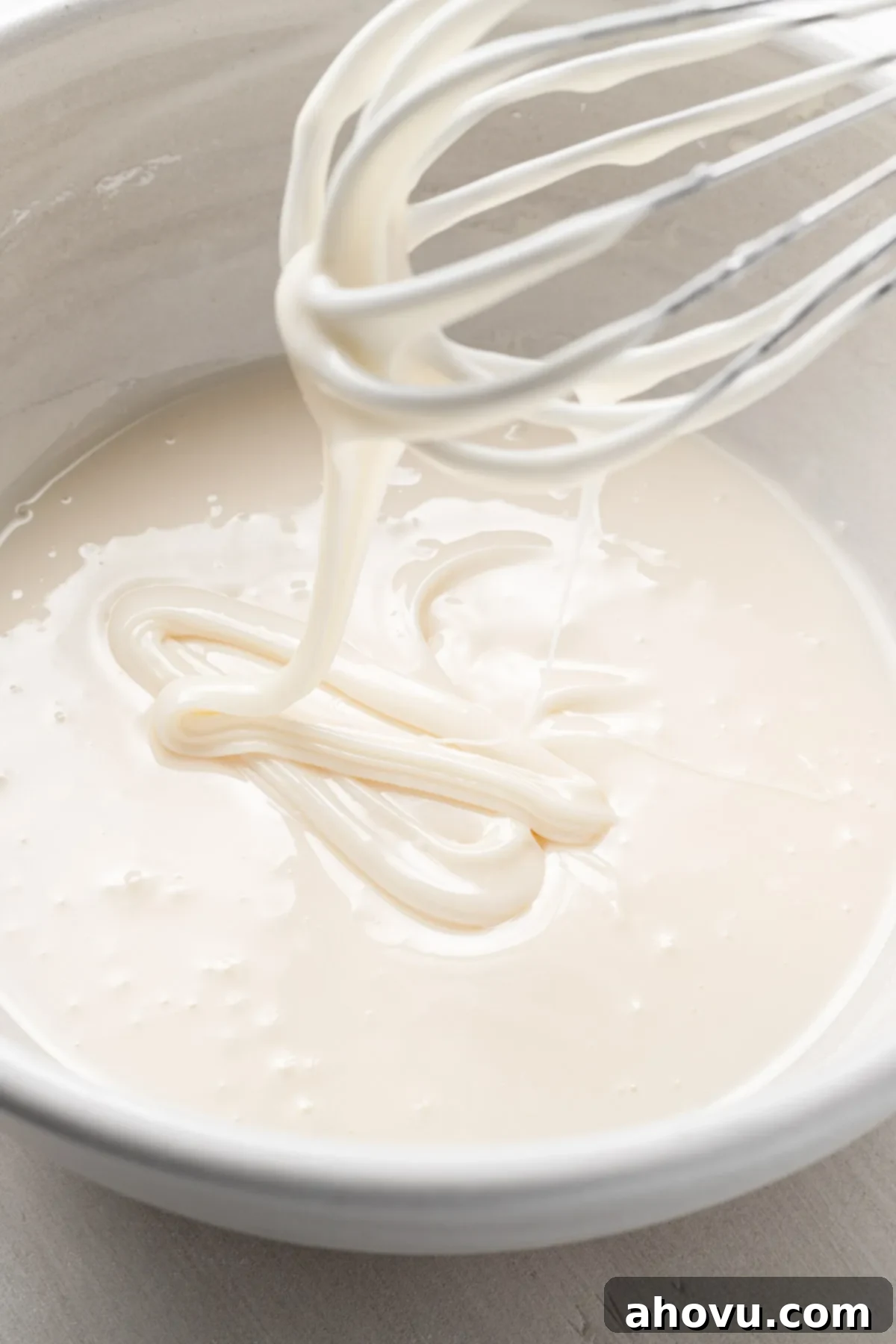
- Now, to achieve the ideal outline consistency, you’ll gradually thin the mixture. Add an additional 1 teaspoon of milk at a time, whisking well after each addition. Continue this process until the icing reaches what we call “outline consistency.”
- This is the perfect point to add your food coloring, if you’re planning to color the entire batch a single hue. Mix it in until the color is evenly distributed and no streaks remain.
- Once your outline consistency is achieved and colored (if desired), transfer approximately 1/3 of this icing to a separate bowl or directly into a piping bag. This portion will be used for outlining your cookies. Keep it separate, as the remaining 2/3 will be further thinned to become your flood icing.
Tip for Outline Consistency: To accurately determine if your icing has reached the perfect outline consistency, lift your whisk or a spoon from the mixing bowl. Observe the ribbons of icing as they fall back into the bowl. If these ribbons take approximately 3 to 4 seconds to melt back smoothly into the surface of the icing, you’ve hit the sweet spot! If it melts faster, it’s too thin; if it takes longer, it’s too thick and needs a tiny bit more milk.
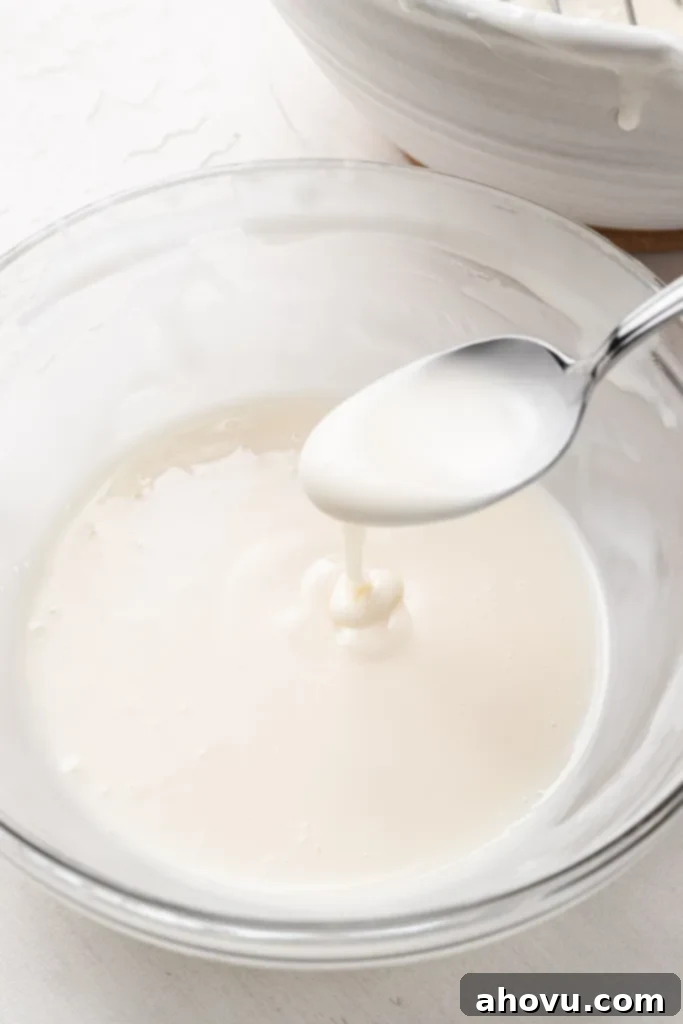
Now, it’s time to prepare the flood icing. This consistency will be noticeably thinner than your outline icing, making it ideal for smoothly filling in the outlined areas of your cookies. Here’s how to achieve it:
- To the remaining 2/3 of your icing (which is currently at outline consistency), gradually add milk. Start by adding 1/2 to 1 teaspoon of milk at a time, mixing well after each addition. The goal is to thin it out further.
- You’ll know you’ve reached the appropriate flood consistency when you lift your whisk or spoon from the bowl, and the icing ribbons quickly and seamlessly melt back into the main body of icing within 1-2 seconds. It should look fluid but not watery. The image above provides a great visual example.
- With both outline and flood icings ready, you can now proceed to decorate your sugar cookies as desired! For a more detailed walkthrough on effective decorating techniques, continue scrolling to the next comprehensive section of this post.


Mastering Sugar Cookie Decoration: Tips and Techniques
Now that you’ve successfully prepared your perfect outline and flood icings, you’re all set to dive into the exciting world of cookie decorating! Precision and a little patience are key here. I highly recommend using two separate piping bags for this task – one for your outline icing and one for your flood icing. If you’ve opted to create multiple colors of icing, you’ll need distinct piping bags for each individual color and consistency.
- Once your outline icing and flood icing are securely in their respective piping bags, snip off a very small piece from the very tip of each bag. The size of this opening is crucial: do not cut the hole too large, or your icing lines will be thick and uncontrolled. A small snip ensures a thin, clean, and precise line, which is essential for detailed work.
- Begin by carefully outlining each sugar cookie with the slightly thicker outline icing. This creates a barrier, or “dam,” that will prevent your thinner flood icing from spilling over the edges. Take your time to create a neat, continuous border around the entire cookie. Allow this outline to set for a few minutes (5-10 minutes) before proceeding; this helps maintain the crispness of your border.
- Next, use the flood icing to generously fill in the entire area within the outline you just created. Gently squeeze the bag, moving the icing around to cover the cookie completely. You may find it helpful to use the very tip of a clean toothpick or a small decorating scribe to gently push the flood icing into corners or to even out the surface, ensuring a smooth, uniform fill.
- If you plan to add sprinkles, sanding sugar, or other edible decorations, now is the time to do so! The flood icing will still be wet enough for the sprinkles to adhere securely. Once the icing begins to harden, sprinkles won’t stick as effectively. For wet-on-wet designs (where you pipe a different color onto still-wet flood icing to create seamless patterns), act quickly after flooding.
- After decorating, it’s crucial to allow the cookies to dry undisturbed. Carefully transfer your freshly decorated cookies to a flat surface, such as a baking sheet lined with parchment paper or a wire cooling rack. Arrange them in a single layer, ensuring they lay flat and do not touch each other. They need to dry in this manner for a minimum of 20 to 24 hours (or even longer in very humid environments) before you can safely stack them without damaging your beautiful decorations. Sealing them in an airtight container in a single layer after decorating and letting them dry will also protect them from dust.

Frequently Asked Questions About Sugar Cookie Icing
How Long Does the Icing Take to Harden?
The top layer of your sugar cookie icing typically begins to harden to the touch within a few hours, often 2-4 hours, depending on humidity levels and the thickness of your icing. However, for the icing to be fully set and durable enough to stack the cookies without the risk of smudging or ruining your intricate decorations, you’ll need to allow a more substantial drying time. Plan for approximately 20 to 24 hours of undisturbed drying. High humidity can significantly extend this drying period, so be patient!
Can the Iced Cookies Be Frozen?
Absolutely, yes! Once you’ve lovingly decorated your sugar cookies and have allowed the icing to fully set and harden (minimum 24 hours), you can absolutely freeze them for later enjoyment. To do so, place the fully dried cookies in a single layer in a freezer-safe bag or an airtight container, separating layers with parchment paper if stacking is necessary. They can be safely frozen for up to three months. When you’re ready to indulge, simply remove them from the freezer and let them come to room temperature on your counter. The icing should thaw beautifully, with minimal impact on its texture.
Can the Corn Syrup Be Omitted?
While light corn syrup is highly recommended for its benefits, it is not strictly essential. You can omit it from the recipe if you prefer not to use it or don’t have any on hand. However, it’s important to understand its role: corn syrup significantly contributes to the icing’s beautiful glossy sheen and helps it set a little faster. If you choose to omit the corn syrup, be prepared for a slightly less shiny finish and potentially longer drying times. To compensate for the missing liquid, you will likely need to add a little extra milk (start with 1/2 teaspoon at a time) until you achieve the desired outline and flood consistencies.
Can I Make This Icing Ahead Of Time?
Yes, this sugar cookie icing is excellent for preparing in advance! You can easily make a batch 1 to 2 days ahead of your decorating session. Store the prepared icing in an airtight container or a piping bag with the tip securely sealed (e.g., with a clip or rubber band) in the refrigerator. When you’re ready to use it, remember to set it out ahead of time to allow it to come to room temperature, which will make it much easier to work with. You might find that the mixture has thickened slightly in the fridge; if so, simply add 1/4 to 1/2 teaspoon of milk or water at a time, mixing well, until it returns to your desired piping consistency.
What if my icing is too thick or too thin?
Don’t worry, consistency issues are easily fixable!
- If your icing is too thick: Add milk (or water) half a teaspoon at a time, mixing thoroughly after each addition until you reach the desired consistency.
- If your icing is too thin: Gradually add more sifted powdered sugar, one tablespoon at a time, mixing until the icing thickens to the correct consistency. Patience is key here to avoid over-correcting.
What kind of sugar cookies work best with this icing?
This icing works wonderfully on any sturdy, flat cut-out sugar cookie. Recipes that produce cookies that don’t spread much during baking are ideal, as they maintain their shape for easy decorating. A classic vanilla or almond-flavored sugar cookie is a perfect canvas for this versatile icing. Ensure your cookies are completely cooled before attempting to ice them!

Expert Tips for Icing Success
- If you’re still on the hunt for a reliable and delicious cut-out sugar cookie recipe, look no further! This is my absolute favorite cut-out sugar cookie recipe, perfectly designed to pair with this icing.
- As mentioned earlier, you can confidently use either liquid or gel food coloring with this versatile icing. However, it’s worth reiterating: liquid food coloring, especially when used in large quantities for deep hues, can thin out your icing. If this happens, don’t despair! Simply add a small amount of extra powdered sugar (one tablespoon at a time) and mix until the desired thickness is restored. For the most vibrant and intense colors without compromising consistency, gel food coloring remains the superior choice.
- To make several different colors of icing from one batch: Once you’ve prepared the initial batch of icing and it has reached the correct outline consistency, divide it evenly among several different bowls, one for each color you wish to create. Add your desired food coloring to each bowl, mixing thoroughly until the color is uniform. Then, from each colored bowl, divide the icing again to create separate portions for the outline and flood consistencies for that specific color. This method ensures you have a full spectrum of colors ready for intricate designs.
- This recipe is designed to yield approximately 1 and 3/4 cups of perfectly pliable icing, which is typically enough to beautifully decorate about two dozen standard-sized sugar cookies. If you’re baking a smaller batch of cookies, you can easily scale the recipe down by cutting all the ingredient quantities in half. Conversely, for a large party or event, feel free to double or even triple the recipe as needed.
- For even smoother flooding, especially for large areas, consider transferring your flood icing into squeeze bottles instead of piping bags. This can offer greater control and a more even distribution of icing, leading to a flawlessly smooth finish.
- Always sift your powdered sugar before adding it to the mixture. This crucial step prevents any unsightly lumps from forming in your final icing, ensuring a silky-smooth texture that’s a joy to work with.
- Ensure all your ingredients, especially milk, are at room temperature. This helps them combine more easily and prevents any shocking of the powdered sugar, leading to a smoother consistency.
More Delicious Frosting Recipes You’ll Love!
- Buttercream Frosting
- Peanut Butter Frosting
- Cream Cheese Frosting
- Chocolate Buttercream Frosting
- Ermine Frosting
Recipe Video

Easy Sugar Cookie Icing
Pin Recipe
SaveSaved!
Leave a Review
Ingredients
- 4 cups powdered sugar (480 grams, sifted)
- 5 to 6 tablespoons milk divided, plus more if needed (75 to 90 ml, any type, room temperature)
- 4 teaspoons light corn syrup (optional, for shine and faster setting)
- 1 teaspoon pure or clear vanilla extract (use clear for pure white icing)
- Optional: Gel or liquid food coloring (gel recommended for vibrant colors)
Instructions
-
To make the outline icing: In a large mixing bowl, whisk together the sifted powdered sugar, 5 tablespoons of milk, light corn syrup (if using), and vanilla extract until well combined and no lumps remain. The mixture will be quite thick at this stage.
-
Gradually mix in 1 additional teaspoon of milk at a time until the icing thins out and reaches an outline consistency. To test, lift the whisk; the icing ribbons should fall back into the bowl and melt into the surface in 3 to 4 seconds. Adjust by adding more milk to thin or more powdered sugar to thicken.
-
If coloring the entire batch, mix in your food coloring until fully combined. Remove ⅓ of the prepared mixture for your outline icing and set it aside in a separate bowl or piping bag.
-
To make the flood icing: To the remaining two-thirds of the icing, add ½ to 1 teaspoon of milk at a time, mixing well after each addition, until it reaches a flood consistency. When you lift your whisk or spoon, the icing should quickly melt back into the bowl of icing within 1-2 seconds, creating a smooth surface.
-
To decorate your cookies: Place the outline icing and flood icing in separate piping bags (or squeeze bottles for flood icing), and snip a very small piece off the tip of each one. First, outline each cookie carefully with the outline icing. Then, use the flood icing to fill in the outlined area. Use a toothpick or small scribe tool if needed to spread the icing to the edges and fill any empty spots, ensuring a smooth, even surface. Add sprinkles immediately if desired.
-
Place the decorated cookies in a single layer on a flat surface or cooling rack in an airtight container. Allow the icing to harden fully for about 20 to 24 hours (or longer in humid conditions) before stacking them to prevent any smudging or damage to your beautiful designs.
Notes
For best results and convenience, I recommend decorating your cookies the day before you plan to serve them, allowing ample time for the icing to fully set. Store your freshly decorated cookies in a single layer in an airtight container while they dry.
To make several different colors: Once the icing reaches the correct outline consistency (before splitting for flood icing), divide the batch into separate bowls for each desired color. Mix in your food coloring. Then, for each color, divide it again to create the outline and flood consistencies.
To make ahead of time: You can prepare this icing 1 to 2 days in advance. Store it in an airtight container in the refrigerator. Before use, allow it to come to room temperature and mix it well. If it has thickened, add a little more milk (1/4 to 1/2 teaspoon at a time) to restore the desired consistency for decorating your cookies.
Milk: Feel free to use any type of milk you have: whole, 2%, 1%, skim, or even almond milk work perfectly fine. For a slightly richer flavor, milk is preferred, but you can also use an equal amount of water as a substitute. Ensure it’s at room temperature for optimal mixing.
Corn Syrup: Including light corn syrup enhances the icing’s shine and helps it set faster. While highly recommended for these benefits, you can omit it if you wish. If omitting, you may need to add a touch more milk to achieve the proper consistency, and expect a slightly less glossy finish.
Vanilla Extract: For icing that’s truly pure white, opt for clear vanilla extract. Otherwise, pure vanilla extract provides a wonderfully rich flavor.